
My most challenging project so far. And one of my most rewarding results.
From electronic reporting to a real field sales management tool.
24 field sales representatives. Four regions. Four regional managers. Two failed reporting systems — and a newly completed application. In terms of resistance, this was probably my most challenging project up to that point.
Starting point
Although the application was called a field sales management system, many future users primarily saw it as another reporting tool. That was precisely the problem: two earlier attempts had already failed. Reports were written, but the benefit to people in the field was barely visible.
The software was largely complete when I took over the project. Instead of simply rolling it out, I first wanted to understand what a day at a dealership actually looked like and where the system would help — or get in the way.
Understand first, then change
I spent a full working day accompanying a field sales representative, then ran workshops in the regions. Resistance was treated as information, rather than an obstacle to the project: Why do users reject something? What extra work does it create? What information do they need themselves?
This perspective made it clear that reporting would only gain acceptance if the system also reduced work for field staff. Dealer data, current communications, visit history, KPIs and the ability to cover for colleagues therefore became more central.
Turning a reporting obligation into a working tool
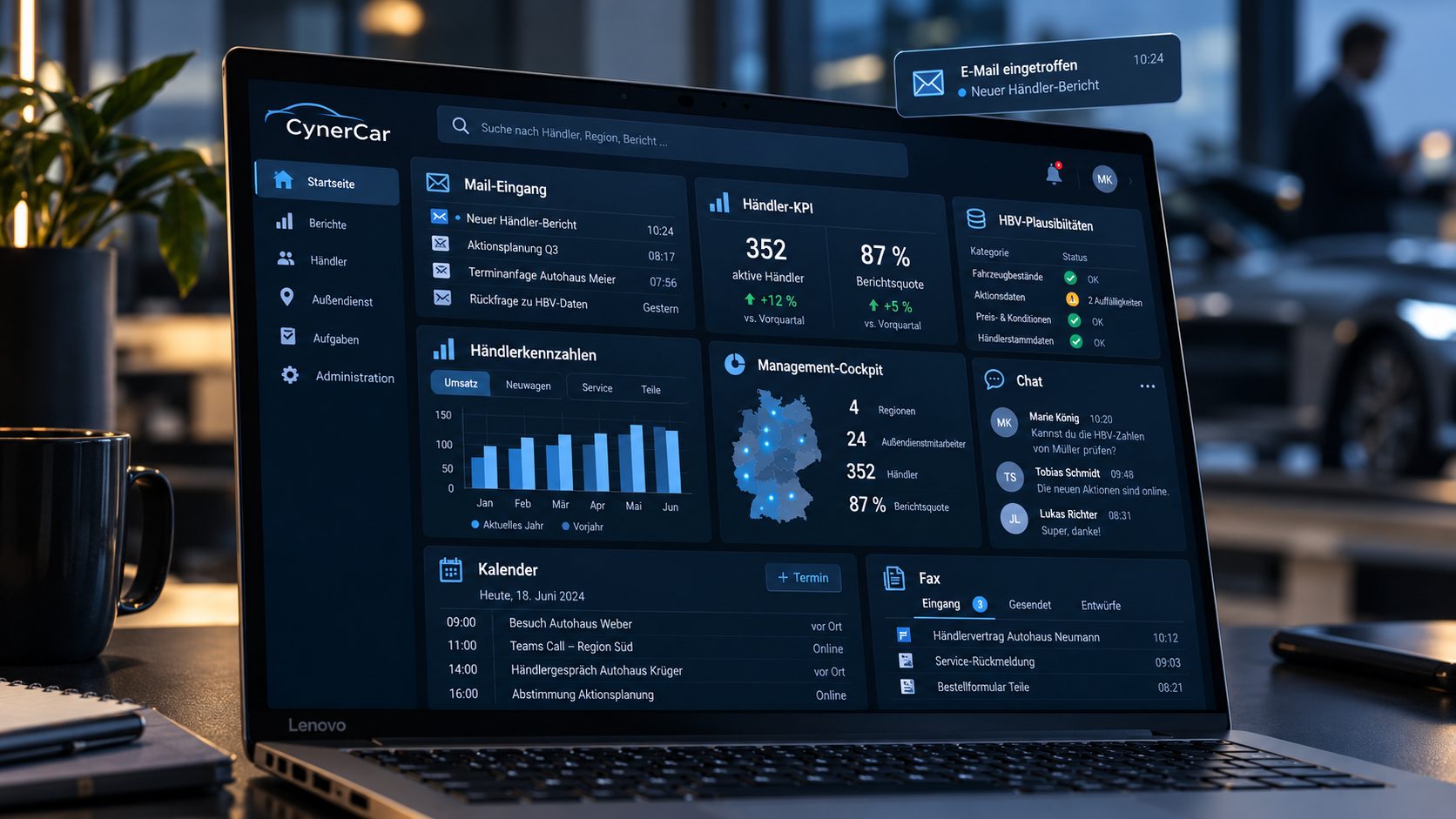
The dashboard brought together information needed before or during a dealer visit. Visit documentation and reporting could be completed on site, reducing follow-up work in the evening. Covering for colleagues on holiday or sick leave also became easier, as their current status no longer had to be reconstructed by phone.
Management was another key factor: a system only thrives if leadership actually uses it. Implementation therefore involved not only training but also changing how information flowed — away from parallel telephone chains and towards a shared information base.
Technology and rollout
The application had to run smoothly on the mobile infrastructure available at the time. That made 2G a real technical benchmark. I coordinated requirements and the external provider, manually tested roles and permissions from different user perspectives and supported business acceptance testing.
After a pilot in one region, the system was rolled out across four regions with 24 field sales representatives and four regional managers, as well as the wider sales and management functions.
What success really meant to me
The achievement was not installing another piece of software. It was turning an unpopular reporting obligation into a tool with clear everyday value. That is the kind of change that still interests me: designing and introducing technology that is not only functional, but actually used.