
AI & Digital Transformation

Understand the problem first. Then choose the technology.

For me, AI is not an island. It is an additional layer that makes sense when it improves a real working or decision-making process.

Why this quote resonates with me

“If you digitise a shitty process, you end up with a shitty digital process.”

Thorsten Dirks · then CEO of Telefónica Germany · translated from German

I could have said this myself. Digitising an unnecessarily complicated or fundamentally flawed workflow will not automatically improve it. That is why I first ask: What problem are we trying to solve, what causes it, and what solution will help in everyday work?

My approach

Four questions before technology becomes a project.

From the real problem to measurable impact: clarify the need, define the value, set boundaries and test results in everyday use.

01

Understand the problem

Clarify the workflow, people involved, causes and actual needs.

02

Define the value

Make the intended benefits specific: less workload, better quality, greater speed or better decisions.

03

Set boundaries

Consider data, responsibility, approvals, compliance and security from the start.

04

Evaluate the impact

What matters is practical usability and measurable improvement, not just a successful demo.

From understanding to action

AI does not start with AI

Since the early waves of generative AI, I have been exploring its practical use in business processes in depth.

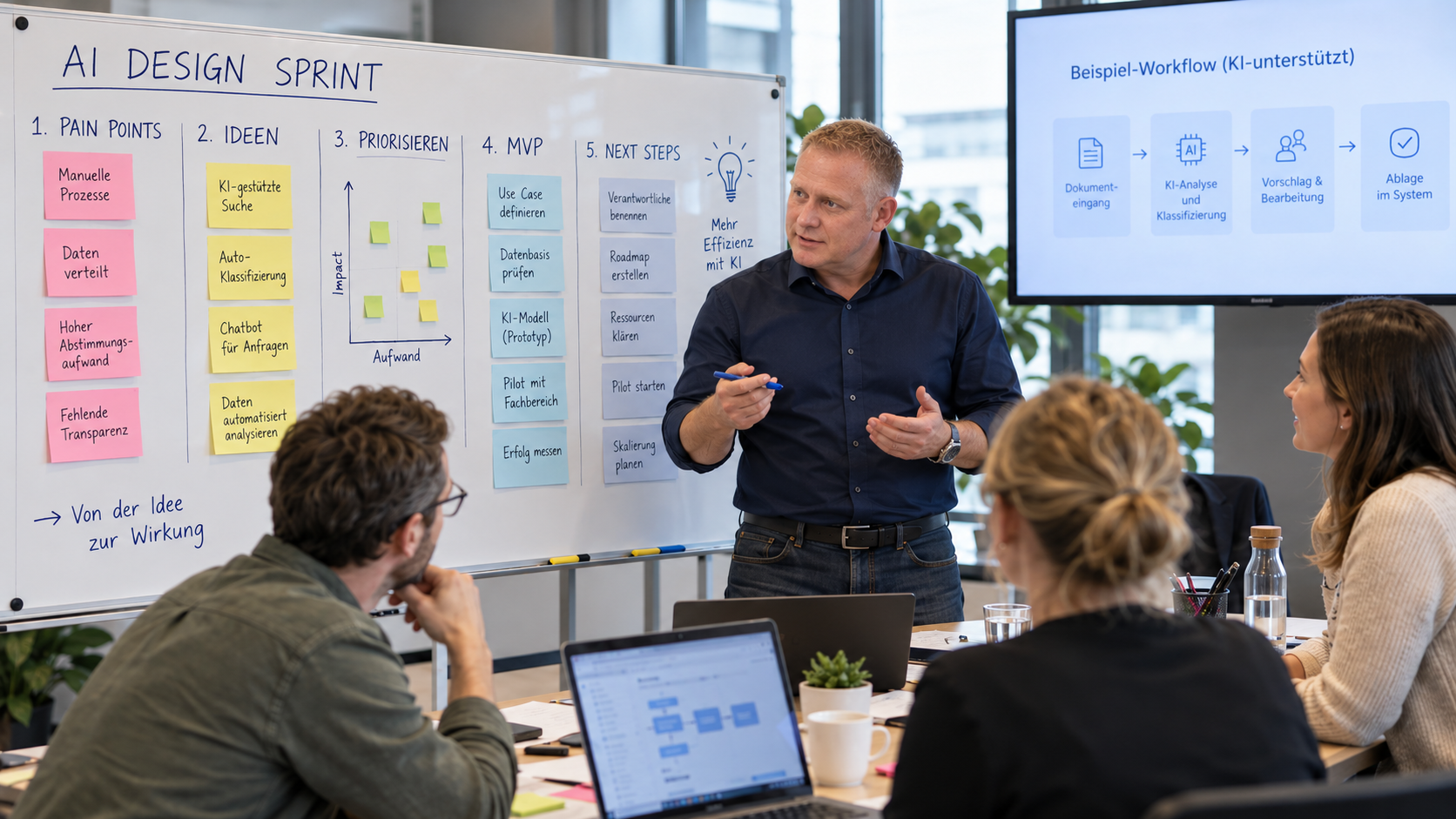
Stephan, without a jacket, facilitates an AI Design Sprint with three participants. Together, they explore problems, ideas, priorities and an MVP at a whiteboard.
Thinking about people, processes and AI together — from the problem to a testable MVP. AI-generated workshop illustration; board content is in German.
01 / Understand

People and processes first

I start with the people who use a process every day. Together, we make workflows, bottlenecks and expectations visible — for example, in an AI Design Sprint. This creates a shared understanding before we start discussing tools.

02 / Focus

Priorities over activity for its own sake

Not every idea needs to become a project. I assess potential use cases by value, feasibility, available data and effort. We start where a manageable solution can make a noticeable difference.

03 / Experiment

An MVP before a major project

A small, working first version makes assumptions testable. A clearly defined use case and early feedback help us discover what works before investing substantial time and budget in a larger solution.

04 / Find the right fit

AI as a tool, not an end in itself

Sometimes a language model helps. Sometimes an interface, conventional automation or a better workflow is enough. I choose the technology to fit the problem, with expert review, data protection and clear responsibilities built in.

05 / Evaluate impact

Keep the economics in mind

A good demo is not enough. Time savings and quality must justify the effort of implementation, use and support. Ongoing model costs, integrations and human rework also belong in the calculation.

06 / Improve

Keep learning

I test new tools, question results and learn from practical use. Feedback from the people involved and measurable impact tell us what to improve, expand or deliberately leave behind.

I do not want to introduce as much AI as possible. I want to find the right problems and develop solutions that work in everyday use, scale economically and genuinely improve operations.
Understand the problem & process

What type of solution fits the need?

Clear rulesConventional software
Disconnected systemsAPI / interface
Recurring stepsAutomation
Language & unstructured dataAI — with quality checks

AI Implementation Architect

My further training, completed in 2026, adds Azure AI, Azure OpenAI, APIs, automation, governance, the EU AI Act and GDPR to many years of project and business application experience.

Tools & methods

From MVP design and AI Design Sprints to generative AI tools, agent workflows and API integration: choosing the right application remains the priority.

Explore AI expertise →